
As teen social media use comes under the spotlight in Australia, where a ban on social media for under 16s has been introduced, the Pew Research Center has published its latest report on social media and AI use among teens, based on a survey of more than 1,458 U.S. teens aged 13 to 17.
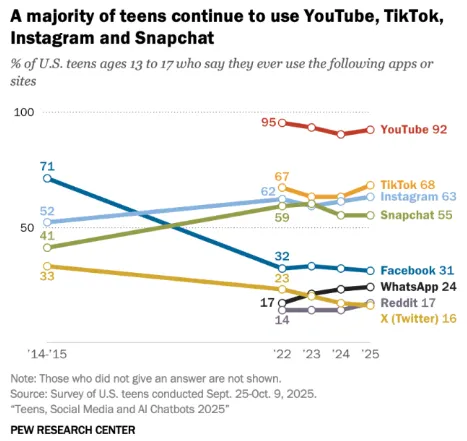
The data shows that YouTube remains the leading app among teens: the vast majority say they use it, followed by TikTok, Instagram and Snapchat.
For creators who look at these numbers as an opportunity, the first practical task is to understand what topics young viewers are actually searching for, and here the guide How to find popular search queries on YouTube comes in handy.
📊 Teens and social media in 2025
The Pew Research study shows which platforms are most frequently used by 13–17-year-olds in the U.S.
🔥 Top platforms among teenagers
- 🎬 YouTube – has been the absolute leader for many years, in 2025 it is used by 92% of teens.
- 🎵 TikTok – confidently holds second place, about 68%.
- 📸 Instagram – used by roughly 63%.
- 👻 Snapchat – still in the game with around 55%.
📉 Platforms losing popularity
- 📘 Facebook has dropped sharply compared to 2014–2015 and now retains only about 31% of teens.
- 💬 WhatsApp – roughly 24%.
- 👾 Reddit – about 17%.
- 🐦 X (Twitter) – even lower, around 16%.
✨ Conclusion:
The overwhelming majority of teens still spend time on YouTube, TikTok, Instagram and Snapchat, while classic Facebook and Twitter are gradually moving into the background for younger audiences.
In practice, this means that brands and creators not only need to be present on these platforms, but also to understand the mechanics of reach, for example by using the breakdown How fast views grow on TikTok.
These are the main platforms for teen interaction on social media, while Facebook, WhatsApp, Reddit and X lag far behind.
There is nothing surprising here: if I asked you which apps teens use, you would probably name exactly these even without seeing the chart. However, it is interesting to note the sharp decline in popularity of Facebook and Twitter/X over time, as both platforms have ultimately become more adult-oriented, pushing young people away.
So if you want to reach a teen audience, you should focus on these platforms, using campaigns that match user behavior patterns (in particular short-form video) in these apps.
When working with TikTok, posting time has a strong impact on initial reach, which is covered in more detail in When is the best time to post a video on Friday on TikTok.
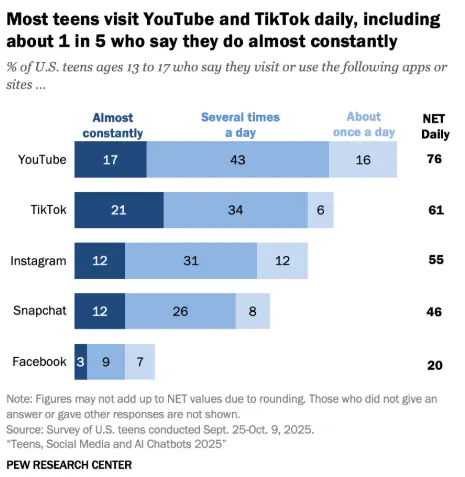
Interestingly, the report also includes more detailed usage data, for example a chart showing which apps teens use most frequently:
📊 How often teens use YouTube, TikTok and other social platforms
The Pew Research study shows how often 13–17-year-olds in the U.S. use different platforms. Only daily use is counted.
🔥 Leaders by daily use (NET Daily)
- 🎬 YouTube – 76% of teens use it every day
- 17% – almost constantly
- 43% – several times a day
- 16% – about once a day
- 🎵 TikTok – 61% use it daily
- 21% – are there almost constantly
- 34% – several times a day
- 6% – once a day
- 📸 Instagram – 55% per day
- 12% – almost constantly
- 31% – several times a day
- 12% – once a day
- 👻 Snapchat – 46% daily
- 12% – almost never log off
- 26% – several times a day
- 8% – once a day
- 📘 Facebook – only 20%
- 3% – almost constantly
- 9% – several times a day
- 7% – once a day
✨ Conclusion:
YouTube and TikTok are the main daily habits for teens, and about one in five admits they are there almost non-stop. Facebook lags far behind for teens and is used much less often.
A separate layer of teen interaction moves into messengers like Telegram, where reactions often replace traditional likes; in such cases it is convenient to have at hand a how-to guide like How to see who reacted in a Telegram channel.
As you can see, YouTube and TikTok are the most popular: 21% of teens use TikTok “almost constantly”.
TikTok’s smart algorithmic systems, which learn and adapt to your interests as you scroll the feed, attract more and more teens who want to stay on top of the latest trends and content from their favorite creators.
These data highlight the significant role TikTok plays in contemporary teen culture in the U.S., and in this context it is interesting to consider what might happen if TikTok is eventually banned in the U.S. as a result of the “Protecting Americans from Foreign Adversary Controlled Applications Act.”
For now, while the platform remains available, it makes sense to use its potential to the fullest, relying on practical frameworks from How to get views on TikTok: Working strategies for growth.
This could happen in the near future, as Chinese officials have not yet indicated whether they will accept the U.S. proposal to sell TikTok.
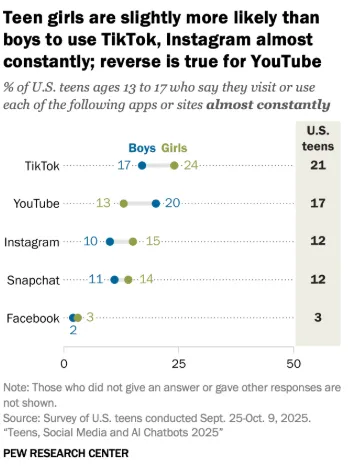
Pew’s data also shows that teen girls are more likely than teen boys to use TikTok and Instagram, while boys are more likely to use YouTube.
📊 Who is more glued to social media: teen boys or girls
The chart shows the share of 13–17-year-olds in the U.S. who use different apps almost constantly.
👧 vs 👦 TikTok
- Boys: 17%
- Girls: 24%
- Average for all teens: 21%
➡ Girls are noticeably more likely to literally live in TikTok.
🎬 YouTube
- Boys: 13%
- Girls: 20%
- Average: 17%
➡ Here too, girls are slightly more “hooked”, although the gap is smaller.
- Boys: 10%
- Girls: 15%
- Average: 12%
➡ Instagram is also more “female” in terms of how much people get absorbed by it.
👻 Snapchat
- Boys: 11%
- Girls: 14%
- Average: 12%
- Boys: 3%
- Girls: 2%
- Average: 3%
➡ Almost no teens are there “almost constantly”.
✨ Bottom line: teen girls are slightly more likely than boys to be constantly on TikTok, Instagram and Snapchat, while the gap on YouTube is smaller, though girls are still ahead.
Against the backdrop of high engagement on Instagram, a very practical analytics question often arises: who exactly liked the post. For that, a detailed breakdown How to see who liked your post on Instagram is useful. Facebook plays almost no role for either gender.
I assume this reflects the popularity of gaming culture and streamers like IShowSpeed, MrBeast and others. These creators are not focused exclusively on games, but they came out of that space and continue to attract huge male fan bases.
Also interesting:
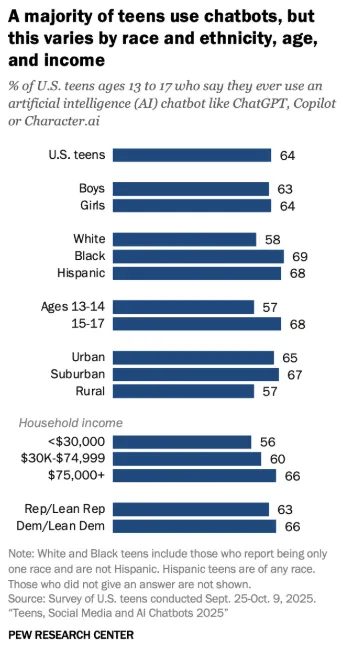
“About two-thirds of teens (64%) say they have ever used an AI chatbot. A smaller share (36%) do not use this tool.”
📊 How teens use AI chatbots
The Pew Research study asked U.S. teens aged 13–17 whether they use AI chatbots like ChatGPT, Copilot or Character.ai.
🧠 Overall usage level
- Nationwide, 64% of teens use chatbots.
- Boys – 63%, girls – 64% → almost no gender difference.
🌎 By race and ethnicity
- White teens – 58%
- Black teens – 69%
- Hispanic teens – 68%
👉 Usage is noticeably higher among Black and Hispanic teens than among white teens.
📅 By age
- 13–14 years old – 57%
- 15–17 years old – 68%
👉 Older teens are much more active in using AI than younger ones.
🏙️ By type of place of residence
- Urban – 65%
- Suburban – 67%
- Rural – 57%
👉 In rural areas chatbots are used less often than in cities and suburbs.
💵 By family income
- Up to $30,000 per year – 56%
- $30,000–74,999 – 60%
- $75,000+ – 66%
👉 The higher the household income, the more often teens use AI services.
🗳️ By family political preferences
- Families leaning Republican – 63%
- Families leaning Democratic – 66%
✨ Conclusion: most teens in the U.S. already use AI chatbots in one way or another, but usage is higher among older teens, those living in cities and those from more affluent families.
Thus, the use of AI-based chatbots is growing among young audiences, and given that this generation will grow up in a world where the latest generative AI tools have always been available, it will be interesting to see how this shapes their approach to such tools in the future, and what it will mean for broader internet use.
When planning content for this audience, it is also important to factor in their search behavior: what topics they look for on YouTube and how quickly videos gain reach. The guide How fast views grow on TikTok helps to deal with this.
You can read the full Pew Research report on teen media use, which contains a lot more detail, here.