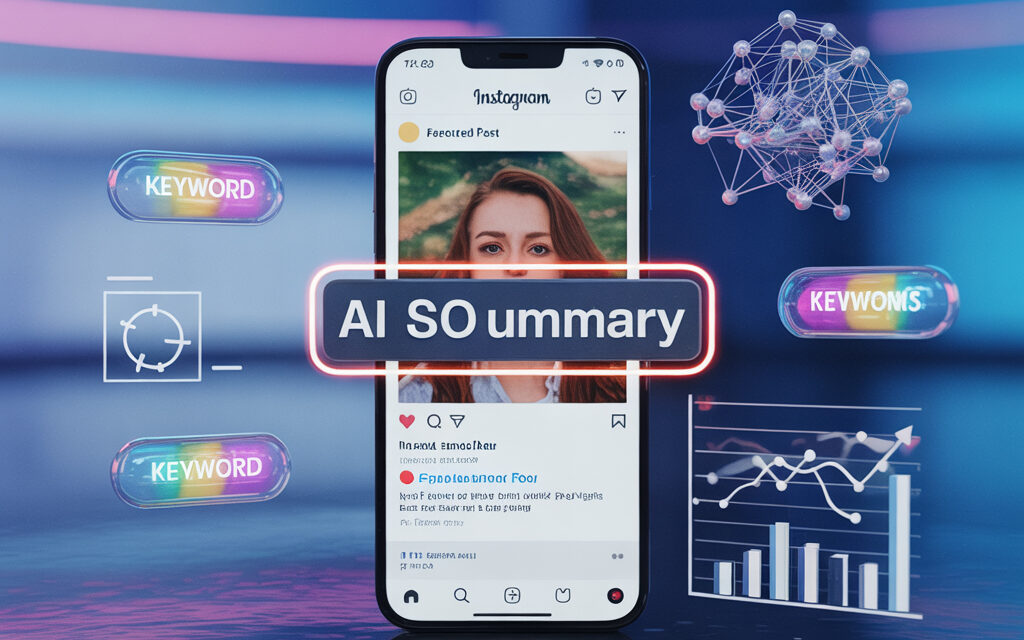
For better or worse, AI bots are gradually taking over the internet, with AI tools generating content that is then processed by other AI tools to produce answers for their own AI systems.
This means that over time, the internet is turning into a copy of a copy of a copy, losing the richness of detail and nuance of original content in favor of an ever-growing stream of AI-generated junk.
That is why this change is so interesting.
This week, 404 Media published a report explaining how Instagram is using AI-generated post summaries to boost its ranking in Google search.

📸 Instagram · jeff_vandermeer123
Title:
🐰 “Meet the bunny who loves eating bananas – a nutritious snack for…” (the rest of the title is cut off).
Caption under the photo:
Photo by Jeff VanderMeer from December 2, 2025.
The recognition system adds: “There may be a lighthouse in the image.” 🌊🗼
As you can see in this example, the “meet the bunny who loves bananas…” description was not written by the author of the post, but added by Meta’s AI to ensure better ranking for this post in search results.
And the captions are actually much longer. 404 Media found another example that read:
“Cosplay photography in Seattle is a treasure trove of inspiration for fans of the genre. Explore these real-life locations and cosplay photos taken by @mrdangphotos. From costumes to locations, learn how to recreate these looks and capture your own cosplay moments in Seattle.”
None of this was written by a human, it was generated by Meta’s AI, which the company confirmed in a statement to 404 Media.
Meta said it recently started using AI to generate titles for posts shown in search results, in order to help people better understand the content.
Although, apparently, the main goal here is not to help people, since the target of these long, keyword-stuffed descriptions is Google itself, in order to maximize the visibility of Instagram content in search.
For creators, this is one more reason not to rely only on automatic summaries, but to think through their own captions for photos – a detailed breakdown of this is in How to caption a photo on Instagram?.
Essentially, this is AI-generated content designed to attract the attention of Google’s AI systems and improve search ranking.
Do we really want the internet to evolve in this direction, where AI bots talk to each other, negotiate their code and decide what is most relevant based on their own digital understanding?
That is a less human internet and a less human-centered experience. But for Meta, it makes sense, and if it can automate the process of bringing more people into its apps, it will.
This looks like yet another example of the “AI effect” or ouroboros, where bots are essentially eating themselves over and over again in an effort to game their own systems.
Of course, there are also concerns about misinterpretation and the risk that these summaries will contain misleading information that does not match what the original poster intended.
It becomes even more important to look not only at auto-generated text but at real audience signals – for example, who is saving posts to bookmarks; this is broken down step by step in How to see who saved your photo on Instagram. Meta will insist that things will improve over time, but the system cannot truly understand why someone posted something, nor can it reliably indicate the source of a caption every time.
It also makes sense to focus on genuine interaction rather than just reach – for that, the guide How to see who liked your post on Instagram is useful.
I suspect the counterargument will be that this brings more people to these posts, which is better for the creator anyway, but it still feels like a step toward a worse user experience driven by re-chewing, repackaging and reusing code-based tricks designed solely to fool another AI system.
And it is only going to get worse. A recent report shows that more than 50% of new articles on the internet are now written by AI, as people look for new ways to monetize the potential of AI tools, mostly through unlicensed and unauthorized copying.
Again, as more AI-generated content is created, more of that content goes back into the grinder, producing new outputs built on misunderstanding, distortion and erosion of human experience.
At what point does the value of AI tools decline so much that they stop being useful in a creative context? And if that happens, what does it mean for the market valuation of generative AI as a product?
This also reinforces my disagreement with social platforms making it easy for anyone to create AI-generated posts directly in the feed.
For those who keep making thoughtful, human-crafted content, it is sometimes more convenient to publish not only from a phone but also from desktop – there is a step-by-step guide for this How to make a new Instagram post from a computer. Social networks are exactly what their name says: they should be “social,” built around communication between people. You can argue about how “social” is defined here and whether interaction with an AI object fits that definition, but at the core of social media lies human communication.
That is something AI bots cannot reproduce. Sure, they can create something that looks similar, but an AI bot has not lived through the experiences that led someone to create a piece of art that truly resonates.
That is the whole point of art and creativity – to celebrate what humans can achieve through passion and dedication. Yet tech enthusiasts seem eager to replace this with a single button that supposedly does the same thing with no effort.
Is that really what people want?
I suspect that if you think so, you are going to be disappointed with the end result.