This article is about why our face in the phone looks like a stranger, while in the mirror it looks perfectly familiar. We’ll break down what optics, light, and the brain do, and how to get photos that are pleasant to look at. We’ll keep it calm, human, and without complex terms.
The Short Answer
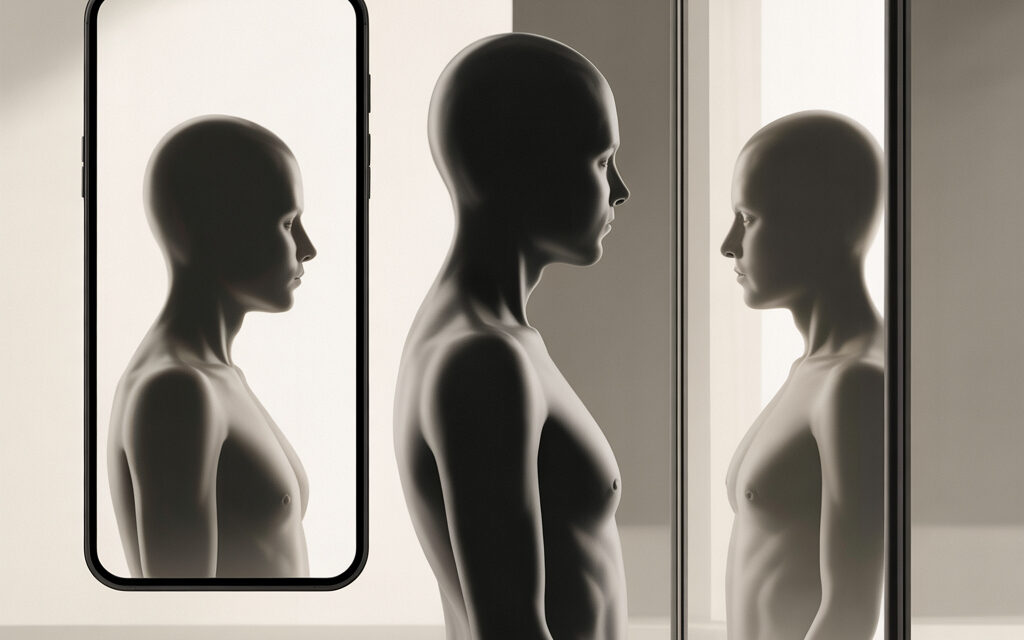
Where do we see our real selves: in the mirror or in photos? In short – neither one is 100% accurate. In the mirror, we see a reflection that our brain is used to. In a photo, we are captured by a specific lens, specific light, and a specific moment, often not the most flattering one. The truth is usually somewhere in the middle, and we can get closer to it with simple things.
Why We Look Different in Photos and Mirrors: What Optics Do
Where do we see our real selves: in the mirror or in photos? Optics add their own truth: the mirror essentially doesn’t care about distance, but the camera does. A phone’s wide-angle camera, when shooting up close, widens the nose and narrows the edges of the face. Plus, the front camera might show a “mirror” preview, but saves the image flipped – this is where the dissonance comes from.
Briefly on Distance
The closer the camera is to your face, the stronger the distortion. A selfie from 30 cm usually “spreads” your features, while a shot from 1-1.5 meters looks calmer and more familiar. If you have a 2x mode, turn it on and step back a bit – the image will become softer.
Front Camera and Reflection
Many phones show a “mirror” preview while shooting to make it feel familiar, but save the image in the gallery as “the world sees it.” Check your settings for a “save as preview” function – this often removes the feeling of “I’ve been swapped out.”
Where is the True Face: Brain Habit or Camera Lens?
Where do we see our real selves: in the mirror or in photos? We like what we’re used to – this is a normal brain reaction, known as the mere-exposure effect. In the mirror, you see a “flipped” version of yourself daily, so it feels warmer. People around you see you unflipped, and a good photo for them often “hits” more accurately. Here’s a small note on the topic from the APA: mere-exposure effect.
A Quick Habit Test
Open your photo and mirror it. Look at both versions for a couple of seconds – usually, one will immediately appeal to you more. That’s habit, not “correctness.” It’s helpful to remember this when something doesn’t sit right with you.
How Light and Background Affect the Result
Where do we see our real selves: in the mirror or in photos? Often, the answer is hidden in the light. Harsh overhead light in the bathroom casts shadows under your eyes and nose, while warm daylight by a window makes skin look smoother. The background also matters: busy wallpaper and bright signs are distracting and “break” the perception.
Light from Above vs. Light from the Side
Light directly from above emphasizes texture and adds a tired look. Light from the side or front at eye level softens shadows and makes the gaze gentler. If you can, stand facing a window or at a 45-degree angle to it.
Background and Color
A calm background helps keep the face as the focal point. Greenery, a plain wall, a light curtain – simple, effective options. I’ve noticed that even a slight turn, stepping away from a busy corner, changes a photo for the better.
Sometimes you get the feeling: Why does the camera make me look lighter? This is usually the work of auto-exposure and HDR — the smartphone tries to “bring out” shadows and even out the face’s lighting, which can make skin look lighter or more contrasty than it appears in the mirror.
Why Does My Face Look Wider in Selfies, But Normal in the Mirror?
Where do we see our real selves: in the mirror or in photos? In an arm’s-length selfie, the camera is closer to the center of the face than to the edges, which makes the nose and the middle of the frame seem wider. In the mirror, the distance is greater, the perspective is calmer. Perspective and distortion are well explained here: Cambridge in Colour.
Checklist for Quick Photos Without a “Wide Face”
- Step back to 1-1.5 meters and use 2x zoom – the perspective becomes softer.
- Place the camera at eye level or slightly higher, not from below.
- Look for even light from the front – a window, cloudy sky, a lamp through a lampshade.
- Lower your chin by about 1 cm and relax your shoulders.
- Clean the lens – it often has fingerprints on phones.
- Take a burst of 5-10 shots using the timer – your chances of catching a good moment are higher.
How to Check Yourself at Home: 3 Simple Tests
Where do we see our real selves: in the mirror or in photos? Let’s check it out without theory. These tests take 5 minutes, and the picture in your head becomes clearer.
Test 1 – Mirror Plus Camera
Stand in front of a large mirror in daylight. Take a photo of yourself in the mirror, then turn around and take a similar photo directly with the camera from the same distance. Compare: you’ll see that the issue isn’t you, but the angle and reflection.
Test 2 – Flipping the Photo
Open a portrait and mirror it in an editor. See which version feels like “you.” Often, the “favorite” face is the mirrored one, simply because we know it better.
Test 3 – Distances
Take three shots: from 30 cm, 60 cm, and 1.5 meters. Life hack: the difference between 60 cm and 1.5 meters changes your face more than you might think. After this exercise, things feel calmer and it’s clearer what to do next.
Real-Life Stories: When a Photo Feels “Not Us,” and When It Does
Where do we see our real selves: in the mirror or in photos? I’ve had a few similar experiences, and they show how much the little things matter.
A Friend’s ID Photo
A friend sent a photo for his ID – he looked tired in it. It turned out they shot it under a lamp from above, very close up. We retook it by a window from about a meter away – his face looked smoother, his eyes more alive, and he said, “Now that’s me.”
My Experience with a Group Photo
At one gathering, I saw myself in a group shot and thought for the first time, “This is how I actually look in real life.” The photographer simply positioned us by a window and shot from slightly above, from about two meters away. That’s when I realized it’s not about “photogenicity,” but about the conditions.
Comparison: Mirror vs. Photo in One Table
Where do we see our real selves: in the mirror or in photos? Let’s put the factors side by side – it’s easier to see what each side is responsible for.
| What Influences | In the Mirror | In a Photo | What This Means |
|---|---|---|---|
| Left-Right Reflection | Everything is mirrored | As others see you | Mismatch with the familiar look causes dissonance |
| Distance and Perspective | Usually greater, minimal distortion | Close up – wide face, far away – calmer | Step back 1-1.5 m or use 2x zoom |
| Light | Often even, ambient light | Can be harsh or mixed | Look for soft, frontal light |
| The Moment | You choose your own expression | The camera captures a specific second | Take a burst, choose the best shot |
| Optics Quality | The mirror doesn’t care | Wide-angle and “curved” edges | Avoid shooting at the very edges of the frame |
| Psychology of Habit | Familiar face is liked more | Unfamiliar look can be off-putting | Give yourself time and compare calmly |
| Auto-Processing | None | Camera may boost contrast, skin tone | Disable “beauty” modes and filters if desired |
Why We Look Different in Photos and Mirrors – A Simple, Jargon-Free Summary
Where do we see our real selves: in the mirror or in photos? We’re not dealing with one truth, but with different representations – optics, light, and brain habit. When you understand them, the tension goes away and clear steps emerge: light, distance, angle, calmness.
Mini-FAQ
Where do we see our real selves: in the mirror or in photos? Neither format is perfect, but together they give a realistic picture. Here are short answers to common questions.
Where do we see our real selves: in the mirror or in photos?
In the mirror – the familiar “mirrored” version. In a photo – the version of how others see you. Both are valid, they’re just different.
Why do I look one way on video and another in photos?
Video smooths out small, unflattering moments because it’s a stream. A photo is a frozen second, and if that second coincides with a blink or uneven light, the result can seem harsher.
Should I use beauty modes?
In my opinion, soft light and good distance are better than a filter. If you use a filter, keep it minimal – just to soften noise, not change your features.
A similar question arises when posting: How to stop Instagram from changing photo colors? Before uploading, check if filters and auto-enhancement are turned off, and save the image without additional color correction – then the tones will stay closer to the original.
Which mode on a smartphone should I choose for a portrait?
Portrait mode or 2x zoom, plus a distance of 1-1.5 meters. This usually gives a calm perspective without a “wide” nose.
Can I learn to like my “non-mirror” self?
Yes. Usually, time and a few good shots taken without rushing and under good lighting help. The brain quickly adapts to a new image if it’s repeated.
Key Takeaways from the Article
Where do we see our real selves: in the mirror or in photos? We all face this question, and everyone has their own answer. But there are some anchor points that work almost always.
- There is no single “real” image – there are different angles on reality.
- Distance and light matter more than we think.
- Brain habit influences how much we like an image – this is normal.
- A couple of simple tests at home can restore peace of mind.
- The best photos happen without fuss, when you’re breathing and not in a hurry.
Glossary
Where do we see our real selves: in the mirror or in photos? If some words seemed new, here are short explanations.
- Perspective – how objects appear depending on distance and shooting point.
- Focal Length – the “zoom” of a lens that affects the compression or expansion of space.
- Wide Angle – a lens that captures a lot of space and distorts close objects more.
- Soft Light – diffused light without harsh shadows, usually from a window or through a lampshade.
- Hard Light – bright, directional light with sharp shadows, often from above.
- Mirroring / Flipping – rotating an image horizontally, like in a mirror.
- Auto-Processing – automatic adjustments made by the camera to contrast, color, and sharpness.
If you want fewer automatic adjustments, it’s useful to know How to turn off HDR on photos? In your camera settings, you can turn off HDR or set it to manual mode – then shots will look closer to natural light without extra “brightening.”
- Portrait Mode – a smartphone mode that blurs the background and simulates depth.
- Timer – a delay before shooting to give you time to get into a comfortable pose and position.
- Mere-Exposure Effect – the tendency to like things more simply because we see them more often.
Feel free to share how it went for you
Where do we see our real selves: in the mirror or in photos?
I’m genuinely curious what worked for you – window light, 2x zoom, the timer, or something else.
And if you’d like, share how it went.